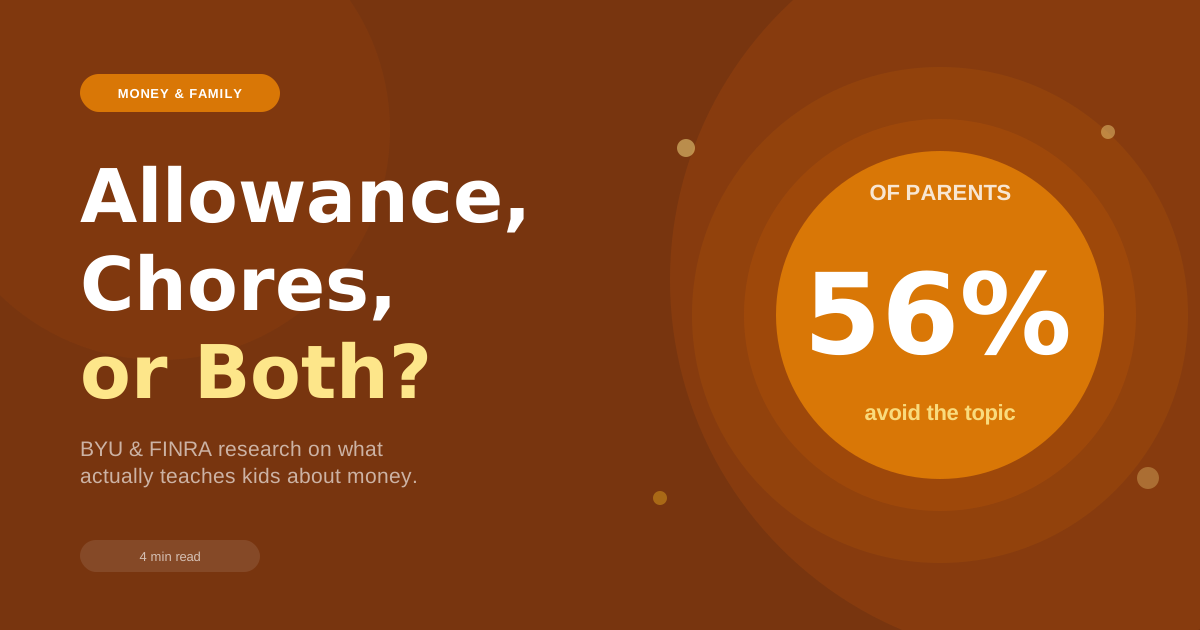
Allowance, Chores, or Both? What Research Says About Teaching Kids the Value of Money
56% of parents avoid talking about money with their kids. Research from BYU and FINRA shows why that silence is costly — and what to do instead.
Most parents want their kids to grow up good with money. Most also admit they don't really talk about it at home.
T. Rowe Price's annual survey — which has tracked over 8,000 parents and children for 14 consecutive years — found that 56% of parents actively avoid money conversations with their kids. The most common reason: “they're too young to understand.” The second most common: “I don't know where to start.”
The research suggests both reasons, while understandable, are costing families more than they realize.
The two camps
When parents do engage, they tend to fall into one of two approaches:
Free allowance: Children receive a set amount weekly, unconditionally. The idea is to give them a budget to manage, without linking it to labor.
Earned allowance: Children receive money tied to completing chores or tasks. The idea is to reinforce that money comes from effort.
Parents debate this endlessly. The research is more straightforward.
What BYU found
Dr. Ashley LeBaron-Black and her team at Brigham Young University conducted in-depth interviews with over 100 parents, grandparents, and young adults. The question: what did your parents teach you about money, and how did they teach it?
“Hands-on financial experience had more lasting impact than any verbal instruction.”
— Dr. Ashley LeBaron-Black, Brigham Young University (2021)
Children on earned allowance developed a clearer mental model of the effort-reward relationship — they associated earning with doing, and carried that into their work ethic as adults.
Children on free allowance developed a different but also valuable skill: learning to allocate and manage a fixed budget. They became better planners.
The key finding: the combination outperforms either approach alone. When children both contribute to the household and manage real money as a result, they develop a more complete financial foundation — including work ethic, budget management, and a healthy emotional relationship with money.
77%
of parents admit they're not fully honest with their kids about money matters.
T. Rowe Price, 14th Annual Parents, Kids & Money Survey (2022)
More than half of the kids in the same survey wish their parents had taught them more.
The evidence that early education works
This isn't just theory. A FINRA Investor Education Foundation study analyzed what happened in U.S. states that mandated financial education in schools.
The results were measurable: credit scores improved by up to 32 points among young adults from mandate states. Rates of credit delinquency — missed payments, defaults — dropped significantly.
Early, real-world financial experience produces better financial outcomes. Not marginally. Statistically and meaningfully better, across entire populations.
A simple framework that works
Based on the research, here's what consistently moves the needle:
Make earning real. Children should exchange effort for money, not just receive it. This builds the most durable lesson about value.
Give them ownership. Once they earn it, it's theirs to manage — spend some, save some. Let them experience both outcomes.
Name the concepts as they happen. “You earned $3 for that.” “You saved toward this for two weeks.” Simple language, said consistently, over months and years.
Model it visibly. LeBaron-Black's research is clear: parents who are observed managing money — discussing trade-offs, saving toward goals — raise more financially capable children. You don't need to be perfect. You need to be visible.
The point isn't perfection
No family gets this exactly right. The research isn't arguing for a perfectly designed curriculum — it's showing that regular, imperfect exposure beats silence.
A chore system that slips some weeks. An allowance that gets renegotiated. A savings goal that changes. All of that is fine. The learning happens in the friction, not in the flawlessness.
Start somewhere. The evidence is clear that somewhere is much better than nowhere.
The best of both worlds
Lootli is designed for exactly this — daily quests connected to real earnings, giving kids the work ethic and money skills that grow together.
Learn more →References
- T. Rowe Price (2022). 14th Annual Parents, Kids & Money Survey.
- LeBaron-Black, A. et al. (2021). How Do Parents Teach Their Children About Work? BYU / Journal of Family and Economic Issues.
- LeBaron-Black, A. (2022). Money and Laundering: How Household Chores Shape Children's Financial Attitudes. Brigham Young University.
- Urban, C. et al. (2015). State Mandated Financial Education and the Credit Behavior of Young Adults. FINRA Investor Education Foundation / Montana State University.